Richard Potter (1726-1806) & William Henry Potter (1760-1848)

Richard Potter is far from being the first to make keyed flutes, as often stated, but he will become an important figure from the moment he introduces his « patent flute » in 1785. His business acumen must have been just as important to his success as the quality of his instruments. 

  • 1745 : Possibly Richard Potter is already established in London (assumption)
  • 1754 : Richard marries
  • 1755 : attested as a flute maker for sure 
  • c.1755 : birth of his first son Richard Huddleston Potter (c.1755-1821), organist, flutist, oboist (no evidence he was seriously involved in instrument making.
  • 1757 : address is « Green Dragon Court » 
  • 1760 : birth of William Henry
  • 1764 : address is « Fleet Street » 
  • 1774 : makes a flute for Irish virtuoso Andrew Ashe
  • 1774 : William Henry becomes apprentice in his father’s workshop
  • 1786 : address is « Johnson’s Court » 
  • 1800 : Richard retires
  • 1806 : death of Richard
  • 1837 : William Henry retires
  • 1848 : death of William Henry (unmarried), leaving a fortune of £30 000.

The signature Potter Senior shall indicate the involvement of his son in flute making, maybe still as an apprentice, therefore between 1774 and 1800. Then, between 1800 /retirement of Richard) and 1806 (death of Richard), William Henry might haves started to sign with his own name. 
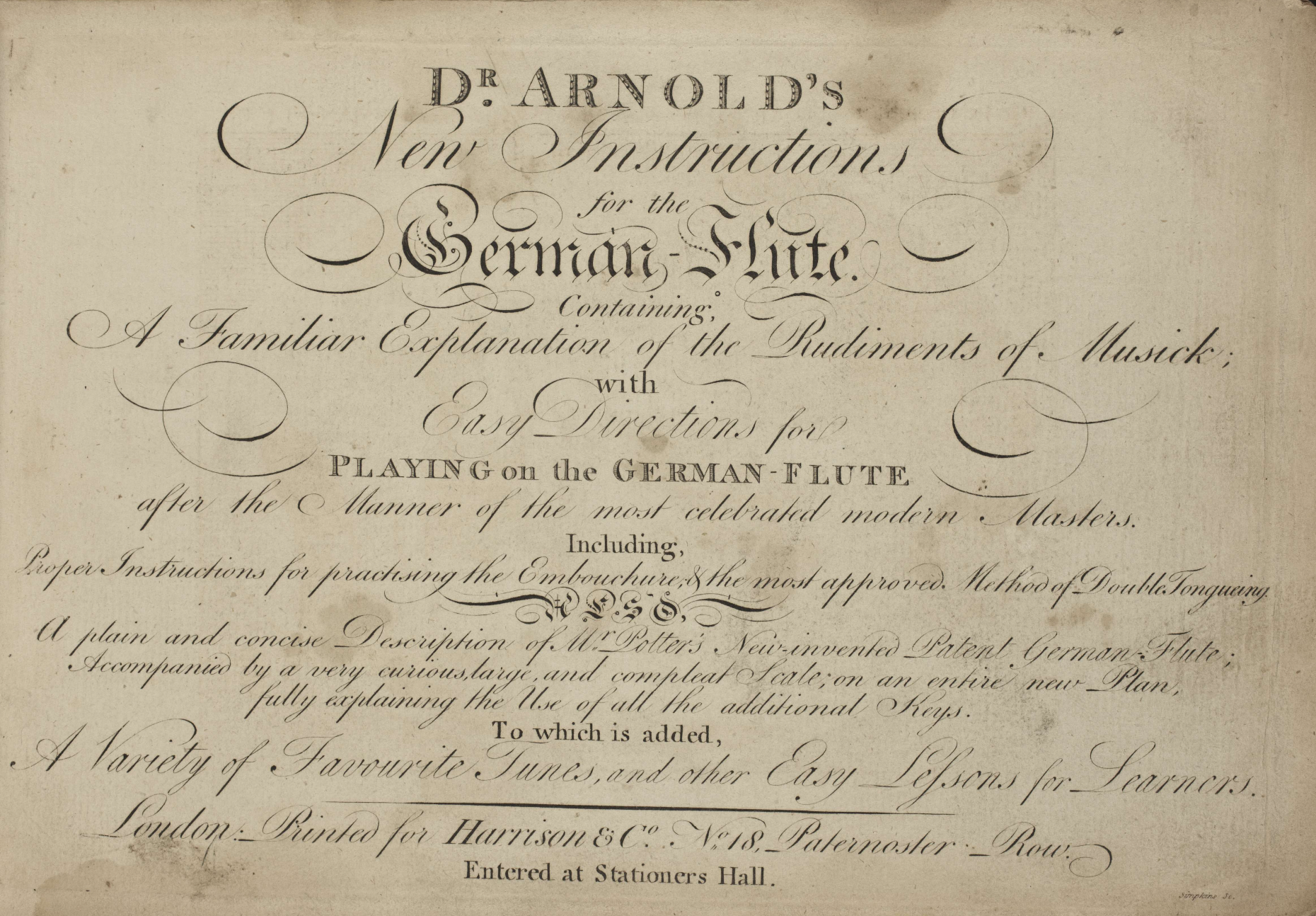
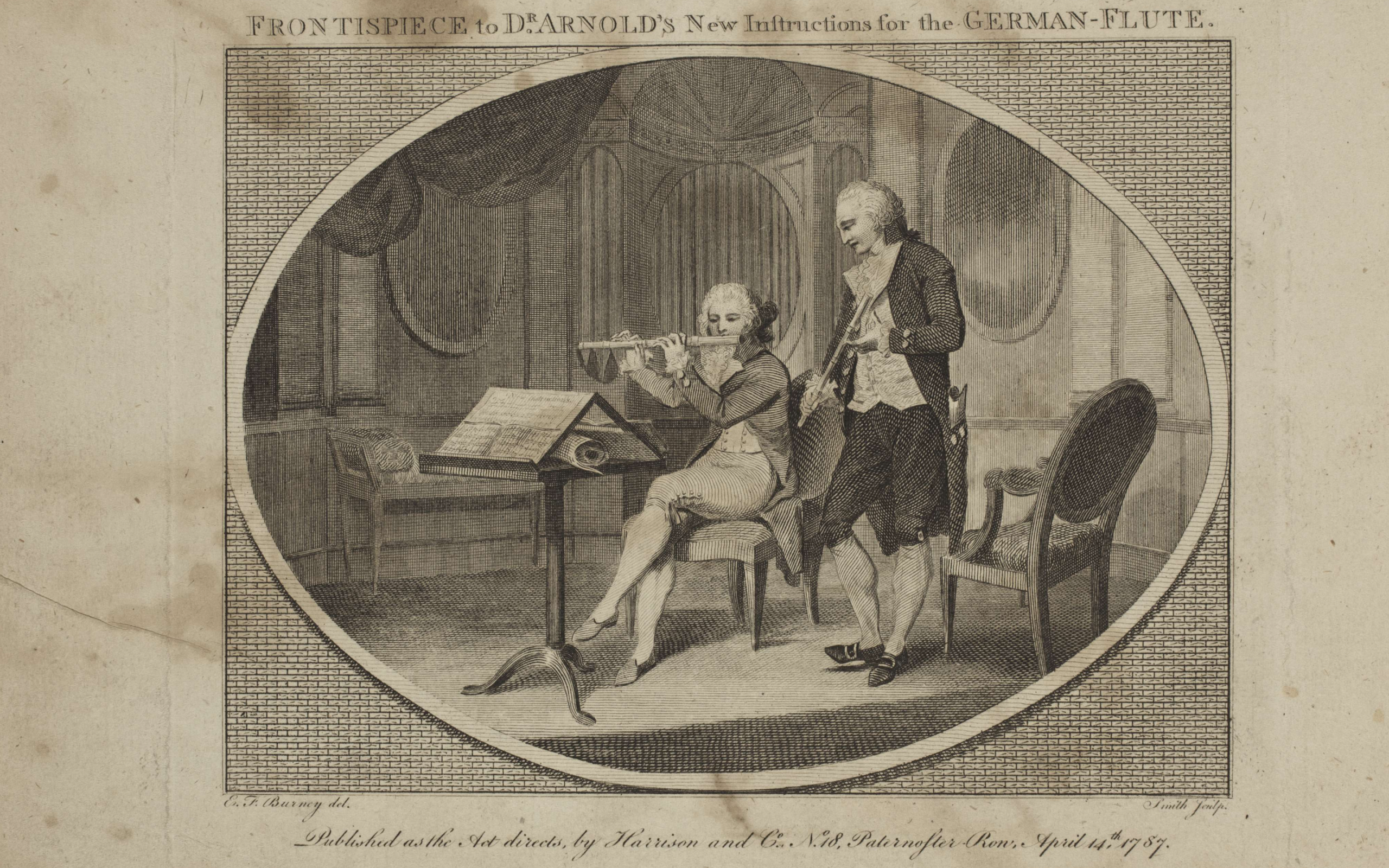
In 1787, a tutor is published :

Dr. Arnold’s New Instructions for the German flute… 
Also, a plain and concise description of Mr. Potter’s New-Invented Patent German-Flute; Accompanied by a very curious, large, and complete Scale, on an entire new Plan, fully explaining the Use of the additional Keys.

(click on images to download the whole book)

https://www.mcgee-flutes.com/PottersGermanFlutePatent.html
A remarkable page by Terry McGee, most detailed and comprehensive… a must read !
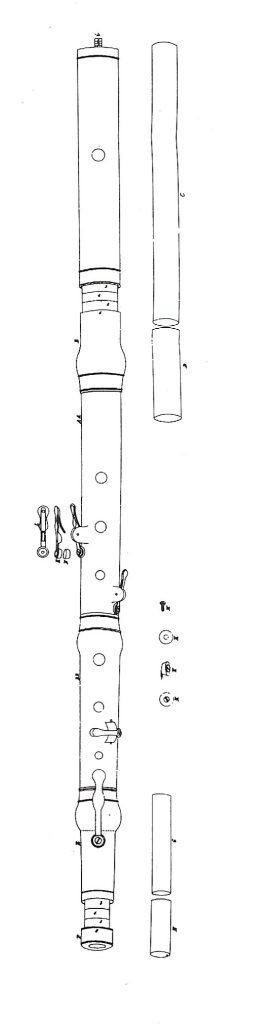
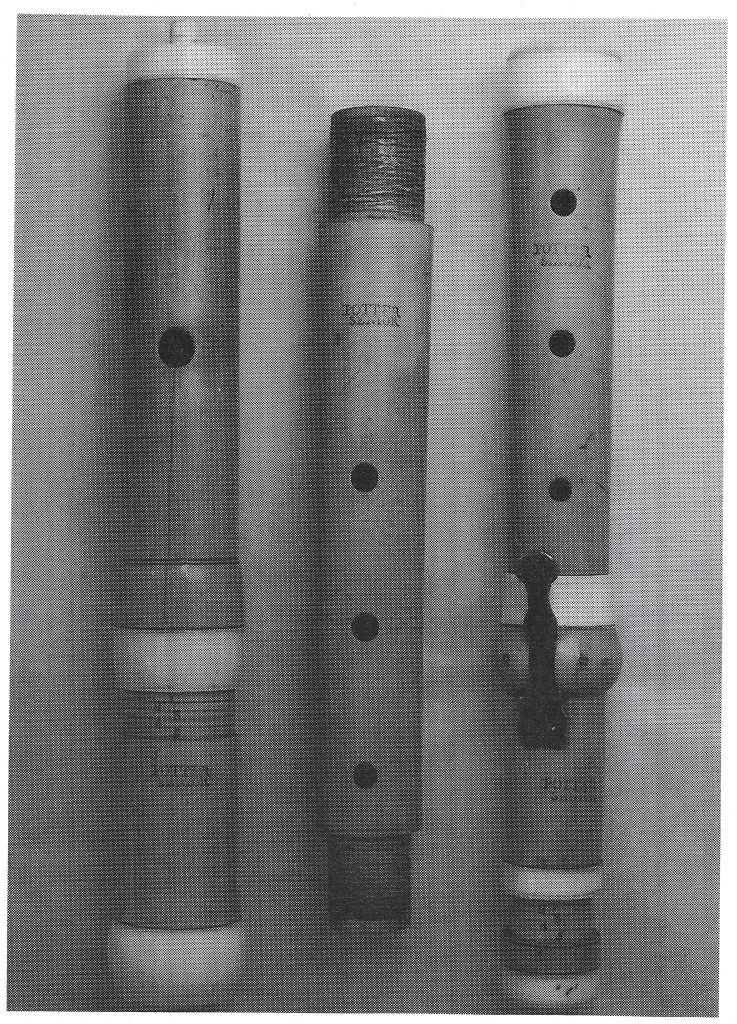
Richard Potter’s 1785 Patent

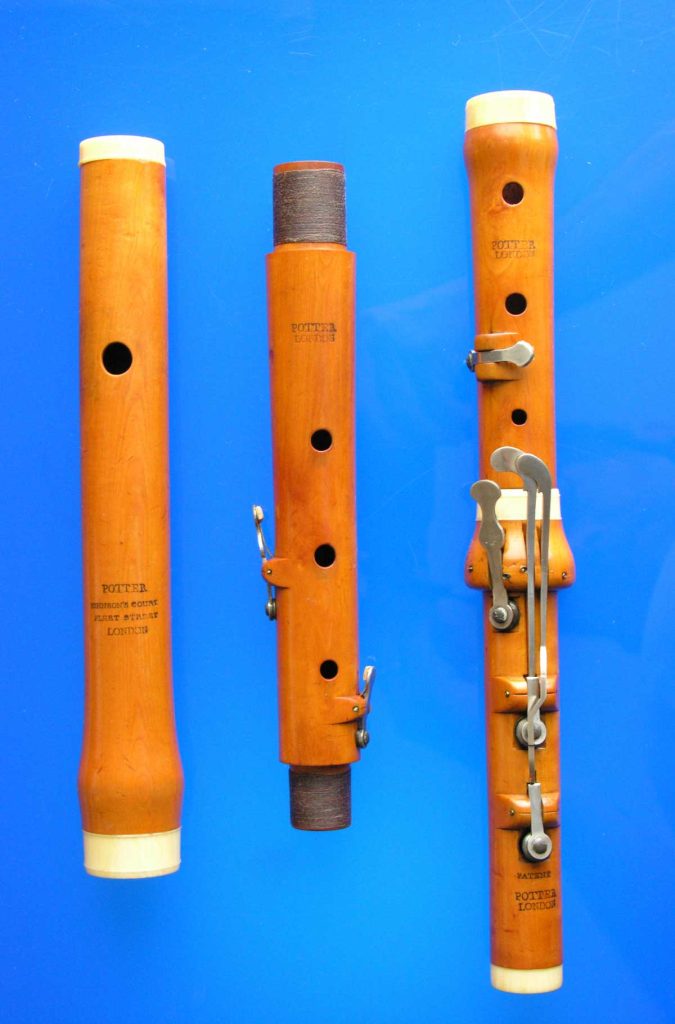
Characteristics :

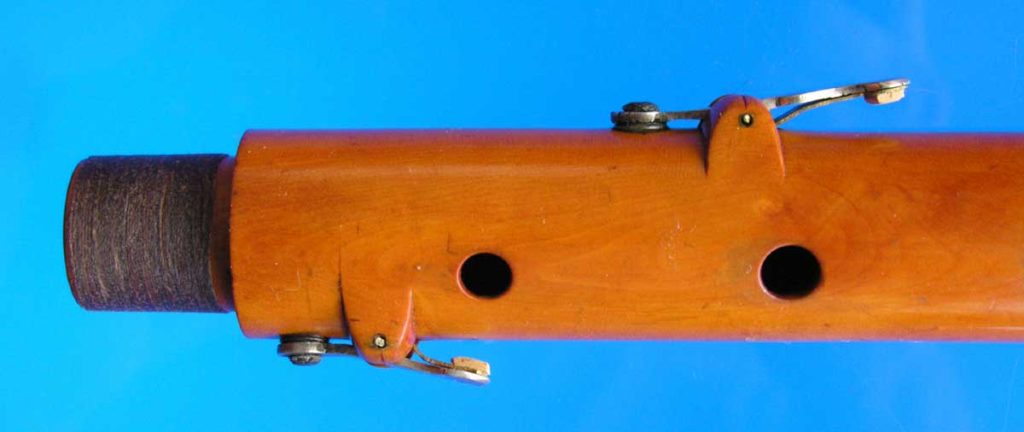
  • head-joint with narrow bore to improve high register
  • round embouchure
  • metal-lined tuning slide which avoids the use of corps de rechange
  • screw cork
  • pewter-plugs
  • foot register
  • numbers on the tuning slide barrel, the foot register and the stopper indicator which help to optimise the settings all tuning devices

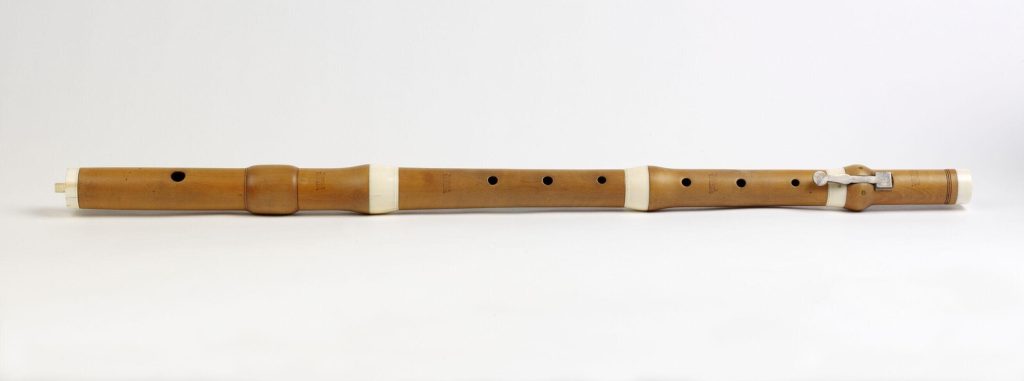
The numbers, in sets of three, are very often 4, 5, 6, and more rarely 1, 2, 3 – a feature found on many English flutes. The absence of the numbers 1 to 3 on the majority of existing flutes leads us to conclude that these do not merely represent relative numbers, but specific pitch levels. The single-key boxwood flute [14.5.47/148] held at the Horniman Museum in London features all six markings, from 1 to 6. It would appear that as the lower pitches fell into disuse, levels 4 to 6 were more frequently favoured.

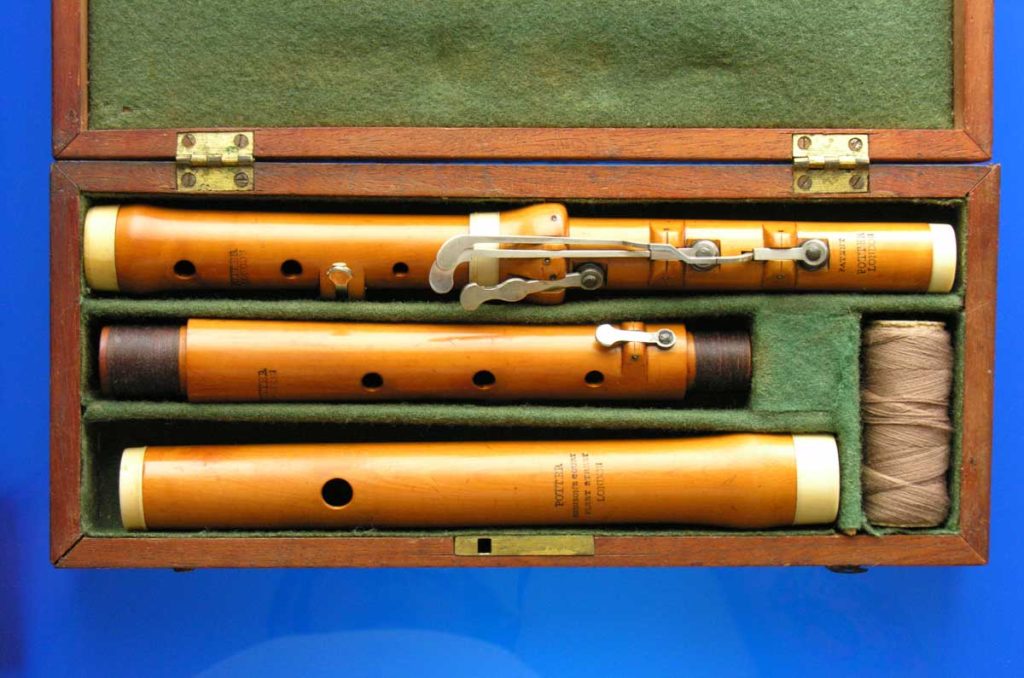
1keyd boxwood flute by Richard Potter, with wooden tuning slide and graduations from 1 to 6, from London Horniman Museum [14.5.47/148]
Richard Potter : flute with wooden tuning slide. Victoria & Albert Museum, London
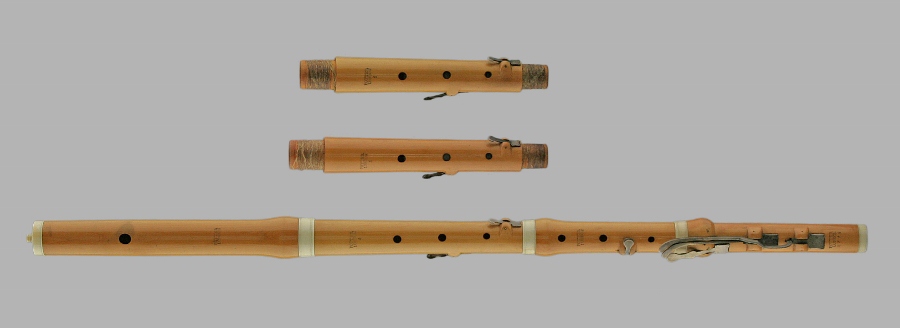
A 6 keyed boxwood Potter before the 1785 pattern : regular flap keys, and corps de rechange instead of tuning slide
8 keyed Potter flute in ebony (Stokholm Museum)

INSTRUMENTS

Instruments by Potter are very numerous. A study of the stamps will help to determine if they are made by Richard or William Henry.

The success of Potter flutes transcended social boundaries and extended far beyond national borders; some instruments can be traced to Vienna, others to Russia (one of them, a single-key flute, is said to have belonged to Tsar Paul I).
It is clear that instruments made according to the 1785 patent influenced instrument-making elsewhere in Europe (particularly in Germany and Vienna), where ‘English-style’ flutes were spoken of and where the presence of features such as pewter plugs – very common in the Viennese flutes of Harrach or Koch – leaves no doubt as to their origin. Johann Friedrich Boie (Göttingen) adopted Potter’s pewter plugs in 1794.

Materials : boxwood, rosewood, ebony, ivory

Some keys are marked I.H., John Hale’s mark, who was working at the Two Flutes and Hautboy, a workshop dating back to Chalres Schuchart and Thomas Collier, which was likely used by many instrument makers (for spare parts such as keys) or dealers (finished instruments on which they affixed their own markings).

Some instruments are dated. (cf. Ardal Powell).