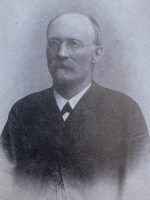
Max Abbas (1844-1923) 🇩🇪
Born in Weimar on 25 May 1844, son of the first oboist of the court, Max Abbas studied there with Kammervirtuoso Theodor Winkler.
He accomplishes his entire carrier within Thuringia :
he was 1st flute of the Hofkapelle of Coburg-Gotha, 1st flute of the Hofkapelle Sondershausen.
During 25 years (1976-1901) he has been flutist of the Bayreuther Festspielorchester.
From 1873, until his retirement in 1910, he was 1st flutist of the Herzogliche (Ducal) Hofkapelle Meiningen.
He served there also as the librerian of the orchestra. Max Abbas died in Hildburghausen in 1923.
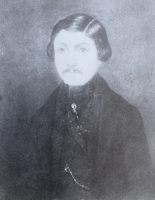
Egide Aerts (1822-1853) 🇧🇪
Born in Boom (province of Antwerp) on 1 March 1822.
He studied flute at the Brussels Conservatoire with François Lahou from 1834 and won 1st prize at the age of 14.
In 1837, he travelled to Paris and, in 1838, toured central France, Milan, Venice and London.
In 1841, when the Boehm flute was introduced at the Brussels Conservatoire, Aerts initially opposed it, but the director Fétis eventually convinced him and he adopted it after a long period of study.
In 1847, Egide Aerts became a flute teacher at the Brussels Conservatoire and principal flutist of the orchestra at La Monnaie Opera House, a position he held until his untimely death at the age of just 31.
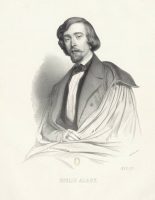
Jules (Giulio) Alary (1814-1891) 🇮🇹 🇫🇷
Born in Weimar on 25 May 1844, son of the first oboist of the court, Max Abbas studied there with Kammervirtuoso Theodor Winkler.
He accomplishes his entire carrier within Thuringia :
he was 1st flute of the Hofkapelle of Coburg-Gotha, 1st flute of the Hofkapelle Sondershausen.
During 25 years (1976-1901) he has been flutist of the Bayreuther Festspielorchester.
From 1873, until his retirement in 1910, he was 1st flutist of the Herzogliche (Ducal) Hofkapelle Meiningen.
He served there also as the librerian of the orchestra. Max Abbas died in Hildburghausen in 1923.
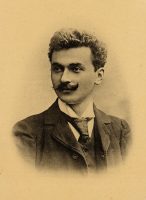
Abelardo Albisi (1872-1938) 🇮🇹
Albisi studied in Parma from 1882 to 1890, with Luigi Beccali and Paolo Cristoforetti.
In 1896 he was spotted by Toscanini who recommended him to Torino orchestra.
In 1898, he succeeded Zamperoni as 1st flutist of La Scala in Milano. There he was active in an action for the return of Toscanini, with whom he was a close friend… until 1918, when a memorable clash occured : Toscanini reprimanded him, and Albisi exploded, insulted him (according to different sources, threw his flute or a music stand at him) ; he had to leave to Switzerland.
From 1918 to 1923, he was 1st flutist of Orchestre de la Suisse Romande.
In 1911, he invented a type of vertical bass flute that he called the Albisiphone.
Ernest Alkan (1816-1876) 🇫🇷
Ernest Morhange (who, like his father Alkan Morhange and siblings, adopted « Alkan » as an artist name) is a member of a rich musical family ; his elder brother Charles-Valentin became a celebrated pianist.
Ernest studied with Jean-Louis Tulou and won the 1st Price at the Conservatoire de Paris in 1832.
In 1840, he (among other flutists) was involved in a competition between Tulou (simple system) and Coche (Boehm flute), he was said to have studied it for a while but eventually not adopted it.
He was later member of the Orchestre du Gymnase in Paris.
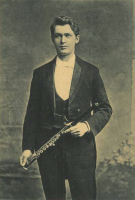
Aldebert Allen (1869-) 🇬🇧
Little is known apart from the informations given by Goldberg…
Aldebert Allen studied with Moritz Fürstenau, Alfred P. Vivian, Joachim Andersen and Richard Rockstro.
From the picture one can see he played the Boehm flute.
He was solo flutist in important orchestras in London and a member of the East Anglian Quartet.
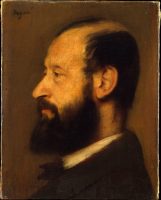
Henri Altès (1826-1899) 🇫🇷
A native of Rouen, Henri Altès began playing the flute at the age of 10 and joined Jean-Louis Tulou’s class at the Paris Conservatoire in 1840.
It was only after winning first prize (in 1842) that he switched to the new Boehm flute, which was rapidly gaining popularity in France at the time, despite Tulou’s opposition.
In 1848, Altès became principal flutist at the Paris Opera, a post he held until 1872.
He was also a professor at the Conservatoire (where he succeeded Dorus) from 1868 to 1893. He trained many pupils, including Taffanel, Lafleurance, Fleury, Barrère and Hennebains, who went on to have prestigious careers. His method, published in 1880, remains a standard reference today.
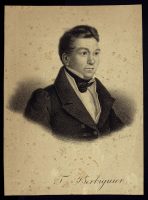
Benoît Tranquille BERBIGUIER (1782-1838) 🇫🇷
A native of Caderousse (near Orange), Berbiguier taught himself the violin, the cello and, above all, the flute – which he played left-handed throughout his life. Against the wishes of his parents, who had intended him for a career in law, he left for Paris in 1805, was admitted to Johann Georg Wunderlich’s class, and won first prize the following year. In 1808 he was appointed assistant teacher in the flute class. His career was interrupted by military service from 1813 to 1819. On his return to Paris, he married the harpist Mademoiselle Plou. In 1830, he retired to Pontlevoy, where he died in 1838. His numerous compositions enjoyed success throughout Europe, where they featured in the repertoires of many leading flutists.
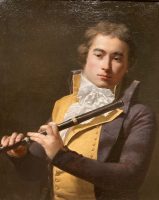
François Devienne (1759-1803) 🇫🇷
Virtuoso of the flute (which he studied with Félix Rault) and of the bassoon.
At his arrival in Paris, Devienne works at the service of the Cardinal de Rohan, and performed frequently as a soloist in the Concert Spirituel and (as a Freemason) in the Concerts de la Loge Olympique.
During the revolution years, he worked as a flutist in the Théâtre Feydeau (where he produced most of his operas) and became later the first flute teacher of the new Conservatoire de Musique (in 1795).
On his death (at the age of just 43), he left behind a substantial body of compositions (chamber music, concertos and operas), as well as a flute method that was to exert a major influence throughout the 19th century.
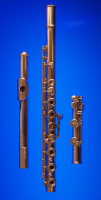
Simon Lauret (1808-1890) 🇫🇷
Son of an officer, Simon Lauret was born on 25 December 1808 in Orléans. He studied in Paris Conservatoire with Joseph Guillou and won the first price, at the age of 15, in 1824. He worked in the Valentino orchestra in Paris, gained a reputation, travelled to Italy in 1834. He finally settled in Marseille where he became teacher in the conservatoire. His playing was noted to be « a combination of sweetness and nobility of tone ; no one knew how to phrase on the flute in a more perfect way, even the pure virtuoso passages he sang to the delight of the listeners ». He switched from the keyed flute (Godfroy) to the Boehm flute after 1855 and purchased not less than 37 silver or wooden flutes to Louis Lot (probably for his students). He died in Marseille in 1890 (26 March).
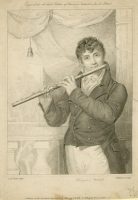
Tebaldo Monzani (1762-1839) 🇮🇹 🇬🇧
Born in Verona, Monzani played the oboe as well as the flute. He moves to London around 1784 and from this moment becomes an active player in the Salomon Concerts and as a first flutist of the King’s Hay Market Theatre.
In 1801 he publishes his Instructions for the German Flute.
In the early years of the XIXth century, he seems to give up playing and concentrate on a commercial activity of publisher, instrument seller and specially flute maker, in association with Henry Hill (from 1807 to 1829), producing instruments of great elegance and quality.
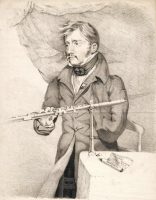
Anne-Toussaint Rebsomen (1789-1854) 🇫🇷
Son of a military, Rebsomen plays the flute and fife from a young age and embraces a carreer in the army. He will be part of Napoleon Bonaparte’s campains.
In 1813, in Hanau battle, he was tragically wounded by a cannonball, which cost him his left leg and his right arm.
He then retired to Normandy where he devised a flute that he could play using only his right hand, which he made himself. In 1830, during a concert tour of England, Cornelius Ward (working for the firm Hill late Monzani) made him another flute.