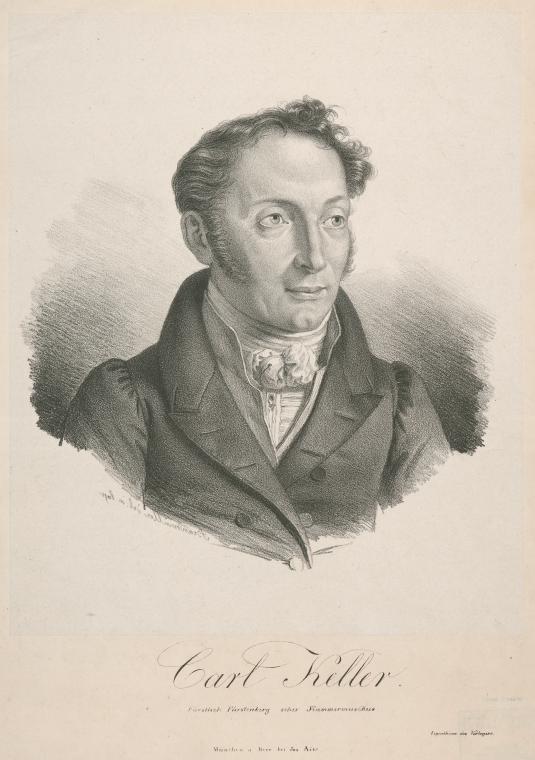
Carl (Charles) Keller (1784–1870)
birth
16.10.1784
Dessau
Germany
death
19.07.1855
Schaffhausen
Switzerland
teacher(s)
August Schroeck
pupils
TIMELINE
- 1784 : birth in Dessau (Anhalt, Germany)
- grows up under musical education of his late father’s colleagues, shows talent as a singer
- 1802 : undertakes to study the flute
- 1804 : after only 2 years, already performs as a soloist
- 1805 or 1807 : meets Reichardt and settles in Kassel, where he plays 1st flute in the Court orchestra
- 1813 : leaves to Stuttgart, and will be 2 years flute player of the orchestra
- 1815-1817 : tours of concerts as an independant virtuoso, France, Hungary, Germany, Holland, spends some time in Vienna
- 1817 : settles in Donaueschingen, where he will become 1st flutist of the Theater, and later will have responsabilities in the direction of the Theater, even acting and singing in some performances.
- 1819 : Ignaz Moscheles dedicates his Grande Sonate concertante pour pianoforte et flûte en la majeur, op. 44, to « his friend Charles Keller »
- 1849 : retires and settles in Shaffhausen, Switerland
- 1855 : dies, age 70.

Karl Keller, aussi dénommé Carl ou Charles Keller, est né à Dessau le 16 Octobre 1784, dans une famille de musiciens. Son père, Johann Gotthilf Keller, était organiste à la Cour de Dessau, mais mourut alors que Karl était encore très jeune. Pris en charge et éduqué à la musique par les collègies de son défunt père, l’enfant fut considéré comme un excellent chanteur, soprano dans ses jeunes années, puis développant un beau timbre de baryton ; c’est à l’âge de dix-huit ans seulement qu’il décide d’apprendre la flûte traversière, et fit des progrès si rapides qu’il se produisait en soliste au bout de deux ans à peine.
Une rencontre important dans sa vie fut celle avec Johann Friedrich Reichardt, gendre du fameux violoniste Franz Benda, qui avait perdu son poste de Maître de Chapelle de la Cour de Prusse pour avoir été trop sensible aux idées de la Révolution Française… Reichardt, qui devint à la fois son professeur et son ami, entraina le jeune homme à Kassel, où il occupa pendant sept ans le poste de premier flûtiste de la Chapelle de la Cour. Il donna aussi des cours de guitare et de chant à la Reine de Westphalie Katharina von Württemberg, épouse de Jérôme Bonaparte. En 1813, la dissolution du Royaume de Westphalie força les souverains à fuir à se réfugier en France ; Keller perdit son emploi, mais exerça deux ans dans l’orchestre de la Chapelle de la Cour de Stuttgart, avant d’entreprendre un carrière de virtuose itinérant. Les documents mentionnent des tournées en Allemagne, Hongrie, France, Hollande, et il se fixa un temps à Vienne.
En 1817, il entra au service du Prince de Fürstenberg à Donaueschingen, dans le sud de l’Allemagne ; il semble que le chef de l’orchestre et compositeur facilita sa nomination. C’est là qu’il rencontra une chanteuse du théâtre de la Cour, Wilhelmine (ou Mina) Meierhofer, qu’il épousa. En 1819, il fut nommé Kammermusikus et premier flûtiste, et ses responsabilités au théâtre s’élargirent progressivement, touchant l’administration, la programmation, la direction : il établit enfin une école de musique. De son côté, son épouse, nommée Kammersängerin en 1826, chantait aussi bien à l’opéra que lors des concerts de cour ou pour les services religieux – tout en enseignant à plusieurs membres de la famille princière.
En 1849, après trente-deux ans de service à Donaueschingen, Keller se retira dans la petite ville de Schaffhausen, en Suisse, où il mourut le 19 juillet 1855.
OEUVRES
Karl Keller, also known as Carl or Charles Keller, was born in Dessau on 16 October 1784 into a family of musicians. His father, Johann Gotthilf Keller, was an organist at the court of Dessau, but died when Karl was still very young. Taken into the care of his late father’s colleagues, who also provided him with a musical education, the boy was considered an excellent singer. He sang soprano in his early years and later developed a fine baritone voice. It was only at the age of eighteen that he decided to take up the transverse flute, and he made such rapid progress that within barely two years he was performing as a soloist.
An important encounter in his life was his meeting with Johann Friedrich Reichardt, son-in-law of the famous violinist Franz Benda. Reichardt had lost his position as Kapellmeister at the Prussian court because of his sympathy for the ideals of the French Revolution. Becoming both the young man’s teacher and friend, Reichardt took him to Kassel, where Keller held the position of principal flautist in the court orchestra for seven years. He also gave lessons in guitar and singing to the Queen of Westphalia, Katharina von Württemberg, wife of Jérôme Bonaparte. In 1813, the dissolution of the Kingdom of Westphalia forced the royal couple to flee and seek refuge in France. Keller lost his position, but spent the next two years in the orchestra of the Stuttgart court chapel before embarking on a career as a travelling virtuoso. Records mention concert tours in Germany, Hungary, France and Holland, and he also spent some time in Vienna.
In 1817, he entered the service of the Prince of Fürstenberg at Donaueschingen, in southern Germany. The appointment appears to have been facilitated by the orchestra’s conductor and composer. It was there that he met Wilhelmine (or Mina) Meierhofer, a singer at the court theatre, whom he later married. In 1819, he was appointed Kammermusikus and principal flautist. His responsibilities at the theatre gradually expanded to include administration, programming and direction, and he eventually established a music school. His wife, appointed Kammersängerin in 1826, performed not only in operas but also at court concerts and religious services, while teaching several members of the princely family.
In 1849, after thirty-two years of service at Donaueschingen, Keller retired to the small Swiss town of Schaffhausen, where he died on 19 July 1855.
QUOTATIONS
Allgemeine Musikalische Zeitung Wien (1818)
Der Concertgeber spielte auf der Flöte ein Concert von Schneider, ein Adagio und Variationen von seiner Composition, und in Variationen für Pianoforte, Violine (J. P. Pixis, Böhm) und Flöte über das Thema: Nel cor più u. s. w., componirt von Herrn J. P. Pixis. Kellers Vorzüge sind bekannt; ein sanfter, weicher Ton, ein graziöser, wohlstudierter Vortrag im Adagio, ein auffallendes Pianissimo, Leichtigkeit in Ausführung der dem Instrumente gewöhnlich mehr zusagenden brillanten Stellen, Harpeggien und Triller (wovon wir jedoch h–c und c–d ausgenommen haben wollen) machen ihn als einen vorzüglichen Flötenspieler sehr interessant; ja, wenn Venus Feste feyern würde, Keller müsste dabey ein Adagio spielen; als Kammer-Virtuose verdient er einen ausgezeichneten Rang, allein bey einem Concertisten liebt man auch Tonfülle, die stete Weichlichkeit bleibt zu einförmig, versetzt wohl den Zuhörer in ein momentanes Wonnegefühl, gibt aber der Kunst selbst zu wenig Leben, um einen allgemein grossen Eindruck zu erwecken. Es ist sehr zu wünschen, dass Herr Keller diess beachtet, da wir ihm — um so mehr bey seiner Bescheidenheit — sehr gerne eine Auszeichnung gönnen, deren sich einige vortreffliche Flötenspieler Wiens zu versichern verstehen.
Allgemeine Musikalische Zeitung Wien (1818)
The performer played on the flute a concerto by Schneider, an Adagio and variations of his own composition, and, together with piano and violin (J. P. Pixis, Böhm), took part in a set of variations for piano, violin and flute on the theme Nel cor più, etc., composed by Mr J. P. Pixis. Keller’s merits are well known: a gentle, mellow tone, a graceful and carefully studied delivery in the Adagio, a remarkable pianissimo, and an ease in executing the brilliant passages, arpeggios and trills that generally suit the instrument particularly well (although we must except the intervals B–C and C–D). These qualities make him a highly accomplished and particularly interesting flautist. Indeed, if Venus were to celebrate her festivals, Keller would surely have to play an Adagio there! As a chamber virtuoso, he deserves an outstanding rank; yet in a concert performer we also appreciate fullness of tone. His constant softness remains too uniform: it may well transport the listener into a momentary state of bliss, but it gives the art itself too little life to make a powerful impression on a wider audience. It is very much to be hoped that Mr Keller will take this into consideration, for we would gladly see him receive the distinction he deserves — all the more so given his modesty — a distinction which several of Vienna’s excellent flautists know how to secure for themselves.
Obituary, contributed by a student of the master (1855) (translation by Tom Moore)
The composer of songs, Carl Keller, died on July 19 at 8 o’clock after a long illness in Schaffhausen, Switzerland. He was born in Dessau in 1784, and thus reached the age of 71! He was also one of the few who had still received a certificate of instruction as a skilled musician. Such letters were formerly provided to tower musicians by the Kapellmeistern of the good old days. As a young man he entered the Chapel in Berlin, daring to take his first step into the wide world of music, full of intrigue. He often told his circle of friends of the terror he felt when he watched the crowds in the city and thought about his future. “Ah, a city which receives so many, will also receive you, and where so many eat, you will not go hungry!” That was his cheering thought as he made his first attempts to find a position. His courage did not disappoint him. Heaven’s blessing was with his brave heart to the end, but alas, the poet’s words came true: “the human heart must little by little be broken”. In the days of King Jerome the young artist came to Kassel, where he experienced the joys of a victorious artist, but suffered by the thought that he did not serve a German prince. Upon Jerome’s expulsion he certainly lost his daily bread, but rejoiced at the thought that his heart depended on Blücher [Gebhard Leberecht von Blücher, contemporary Prussian general] and Germany’s glory. Keller was in Kassel for seven years, then in Stuttgart for two years, until he found a carefree and comfortable position with the princes of Fürstenberg as a chamber musician, which was sweetened by his marriage to a lovely daughter of the Court Actor of the Duke of Baden, Mayerhofer. At Donaueschingen his Lieder began to follow, to pour forth “all of Germany”, fresh and inward. Here he also composed much for the flute, and songs that were adopted by the people. Who does not know the polonaise: „Kennst du der Liebe Sehnen? » and the song of the canteen: „Helft Leutchen mir vom Wagen! » or “Land meiner seligsten Gefühle! » He loved to worked and worked until the end of his life; for we have a guitar method and a flute method by him in the press. In 1848 there was a notable impact on the princely Chapel; most of the musicians were pensioned off, and only a chamber music ensemble remained. Keller, a devoted servant of his Prince Carl Egon, whom he would always refer to as “my dear Prince”, had painfully to leave Donaueschingen, because he wanted to supplement his pension through income from teaching lessons. He moved to the nearby Schaffhausen, where the leading families had welcomed him in happier summer months. Keller was noble in nature, through and through. His songs were sung gladly everywhere, and made his reputation. His true heart beat its last on foreign soil; thus, grant his name a place in your esteemed newspaper, a place for the amiable singer, who passed away on July 19th, without the German press yet reporting it! A grateful student.

INSTRUMENTS PLAYED BY KELLER
« Panaulon » flute to low G. (source ??)

CATALOGUE
11
14
15
16
20
24
27
28
30
35
37
38
41
51
58
Grandes variations pour la flûte
Grandes variations pour la flûte
Concerto [d] pour la flûte
6 Divertissements
Deuxième Concerto [C] pour la flûte
Troisième Grande Polonaise
Der Traum
3 Fantaisies
Sérénade
6 Danses (4 Walzes et 2 Ländler)
3 Divertissements sur des airs hollandais
8 Gesänge
3 Fantasien nach Opern-Melodien
3 Fantaisies pour flûte
3 Divertissements sur des motifs d’opéra
fl, p
fl, vl, va, guit
fl, orch
fl,
fl, orch
fl, orch
V, guit
fl
fl, vl, vc, guit
fl
2fl
VV, p
fl
fl
2fl / fl, vl / fl
1825
1827
1826
1830
1834
1845ca
1837
1845
Böhme
André
Peters
Peters
Peters
Spehr
–
Peters
André
Simrock
Schott
Breitkopf
Spehr
Schott
Schott
–
–
Mr le Prince Charles Egon de Furstenberg
aux amateurs
à son ami Ch. Burckhardt
à son ami Monsieur Schröck
–
–
à son ami Monsieur Burckhardt
aux amateurs de musique agréable
–
–
–
–
–
–
–
–
–
–
–
6 Divertissements
Brilliant solos for the flute
Fesca’s celebrated pot pourri
Der junge Krieger
Arietta alla polacca Conosci tui martiri?
Der Blinde
fl
fl
fl, p
V, guit
V, p
V, p
–
–
–
1833
1839ca
Peters
Ewer
Cocks & C°
Simrock
Wessel & C°